Reeoka LLC
30 N Gould St, Ste N
Sheridan, WY 82801
United States
info@reeoka.com

30 N Gould St, Ste N
Sheridan, WY 82801
United States
info@reeoka.com

How sadness shows up in young children, why "you'll make new friends" lands badly, and five ways to give a goodbye a shape a child can manage.
For a small child, a friend moving away is often the first real goodbye. Not a goodbye until tomorrow, but one with no clear end. It can be hard for adults to take it as seriously as the child does, because we know there will be other friends. The child does not know that yet, and even if they did, it would not help much today.
Young children rarely say “I am sad that my friend is leaving.” More often the feeling shows up sideways: they are slow and floppy, they do not want to go to preschool, they snap at a sibling, they ask the same question about the move again and again, or they seem fine for a week and then fall apart over a broken crayon. All of these can be the same feeling looking for somewhere to go.
It also tends to come in waves rather than all at once. A child can be heartbroken at breakfast and happily playing by lunch. That is not a sign the sadness was not real. It is how young children process big things, in small doses they can manage.
The most common responses come from love and a wish to make the hurt stop: you’ll make new friends, don’t be sad, you can video call. Each of these jumps straight to the solution. To a child, they can sound like the sadness is a problem to be fixed quickly, and that a grown-up is uncomfortable with it.
What helps more is staying with the feeling first, and offering the solutions later, if at all.
A goodbye with something to do is easier than one that just happens. Children do better when the ending has a beginning, a middle and an end they can see.
Over time, the sadness gets lighter. It does not need to disappear before a child can enjoy things again. Missing someone and having a good day can happen together, and that is a useful thing for a child to discover.
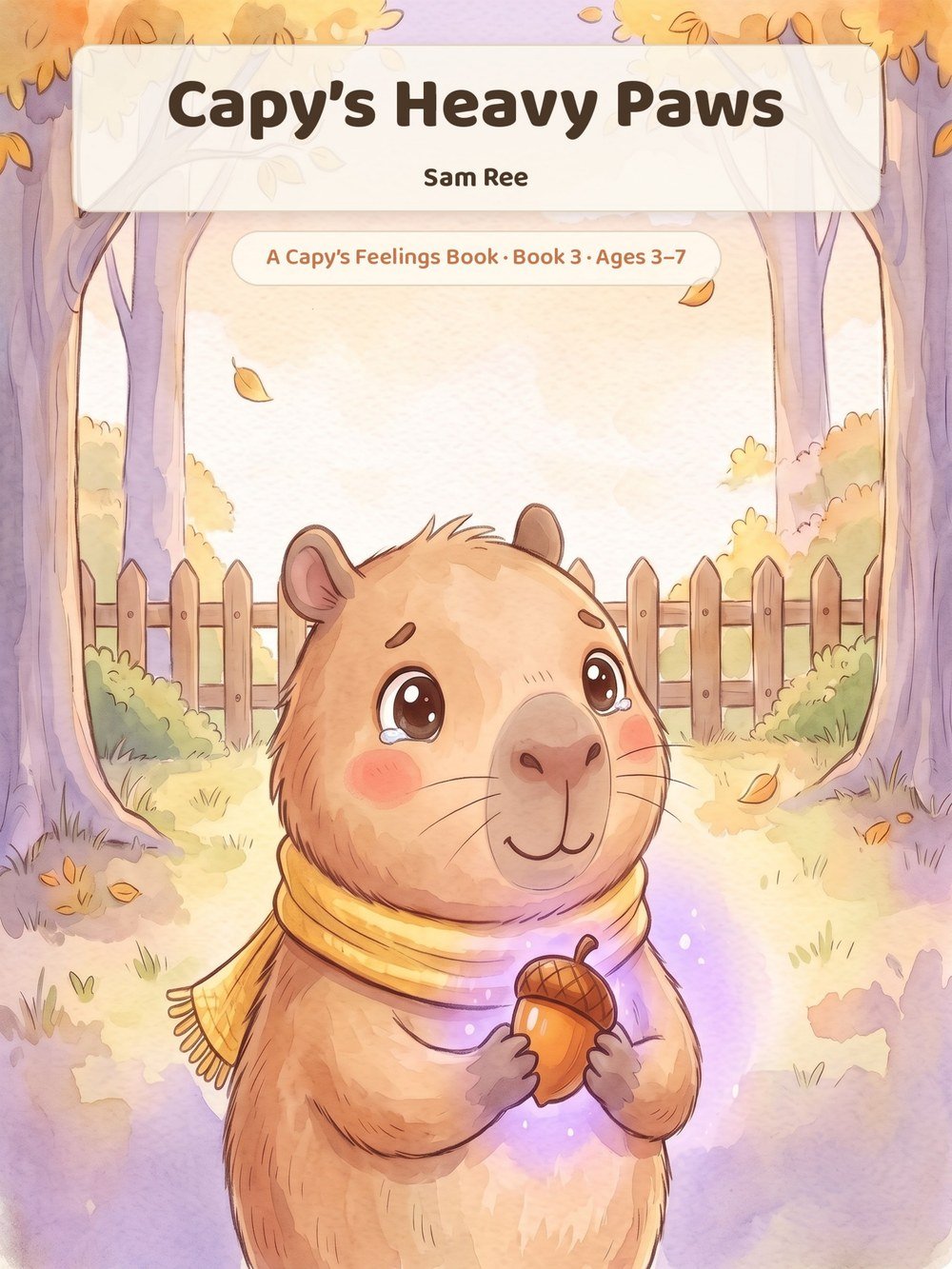
Capy’s Heavy Paws follows exactly this shape over four days: the news in the clover patch, Pip the hedgehog’s last day at the woodland preschool, the empty spot where Pip used to play, and the picture Capy finally sends to Pip’s new forest. Mama never tells him to cheer up or promises him a new friend. She names the feeling, says she feels sad too, and stays close. Pip leaves Capy an acorn, and the book leaves a child with a phrase to reach for: My paws feel heavy. That’s okay.
This is general parenting writing, not medical or psychological advice. If a child’s distress is frequent or intense enough to worry you, a pediatrician or a child psychologist is the right next step.
