Reeoka LLC
30 N Gould St, Ste N
Sheridan, WY 82801
United States
info@reeoka.com

30 N Gould St, Ste N
Sheridan, WY 82801
United States
info@reeoka.com

Why coloring helps children remember places, and a simple five-step screen-free routine for learning one country at a time, ages 5 to 12.
Most children meet the rest of the world as a list of names. France, Japan, Kenya, Peru. Names are hard to hold onto. A pyramid, a kangaroo or a bowl of noodles is much easier, and a picture you colored yourself is easier still.
That is the simple idea behind using coloring pages to learn countries: the child spends ten or twenty quiet minutes with one place, and the place gets attached to something they made.
Coloring keeps a child’s hands busy and their attention on one image for far longer than a flashcard or a video clip would. That slow attention is when questions arrive: why is that building pointy, what is that animal, do people really eat that. Those questions are the real lesson. The page is just the reason to sit still long enough to ask them.
It also suits a wide age range. A five year old will color the Eiffel Tower and remember it is in France. A ten year old can find France on a map, name its neighbours, and look up how tall the tower is.
For learning rather than just passing time, look for pages that show something real and recognisable from each place, not a generic cartoon in a different hat. Thick, even outlines and large open shapes matter too. A page a child can finish in one sitting gives them the satisfaction of a completed country, which is what makes them come back for the next one.
It works at home, on long journeys, on rainy afternoons, and in classrooms as a calm start or end to a geography lesson.
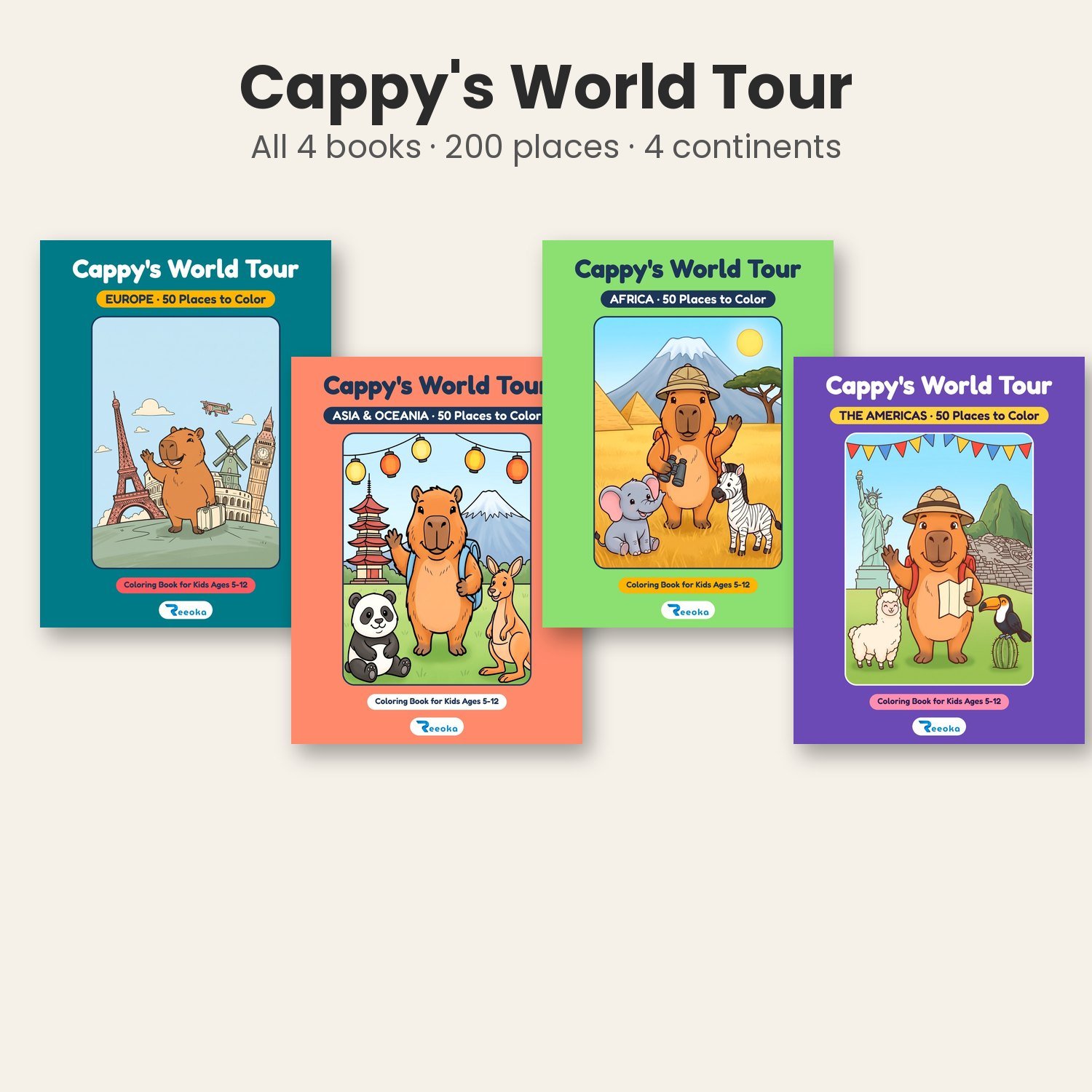
Our Cappy’s World Tour series is built around exactly this routine. Cappy the capybara visits 50 places in each book, from the Eiffel Tower to the kangaroos of Australia, with a real landmark, food or animal on every page and a passport stamp in the corner to color and collect. Each book includes a passport ID page, a stamp checklist and three sticker sheets, in bold and easy outlines for ages 5 to 12. There are four books: Europe, Asia & Oceania, Africa and The Americas, and the complete set finishes with an Official World Explorer certificate.
